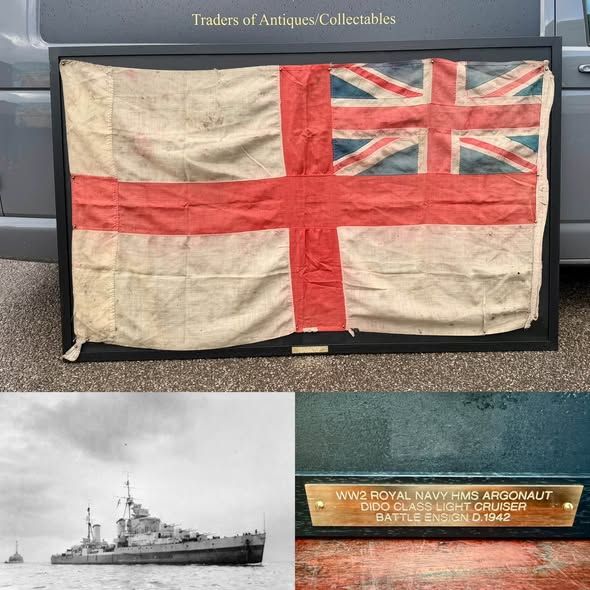
Original WWII Royal Navy Linen Battle Ensign from Light Cruiser HMS Argonaut d.1942
HMS Argonaut was a Dido-class light cruiser of the RN, built by the Cammell Laird Shipyard, Birkenhead, commissioned in 1942.
After work up, in October and November 1942, Argonaut served as part of Operation Torch, the Allied landings in North Africa. The cruiser formed part of Force H, based in Gibraltar and commanded by Vice Admiral Sir E.N. Syfret. It was charged with guarding the landings against possible attack from Italian or Vichy French naval forces, by December, Argonaut joined the newly formed Force Q, commanded by Rear Admiral Cecil Harcourt, with the mission of disrupting German–Italian convoys on the Tunisian coast. In addition to Argonaut, Force Q included the cruisers Aurora and Sirius, and the destroyers Quentin and HMAS Quiberon, and all took part in the Battle of Skerki Bank, attacking and largely destroying an Italian convoy.
During that month, she was heavily damaged when the Italian submarine Lazzaro Mocenigo struck the cruiser with two torpedoes from a spread of four, causing serious damage. The bow and stern sections of the cruiser were effectively blown off and the steering wrecked. Though only three crew members were killed, the damage was so severe that German authorities mistakenly believed the Argonaut had been sunk.
After extensive repairs and the renewal of her radars, she took part in bombardment duties on D-Day under the command of Captain Longley. It also supported the Allied invasion of Southern France, Operation Dragoon, before seeing duty as an escort carrier flagship. Subsequently, the ship conducted a sweep of the Aegean Sea, sinking a number of small Axis craft, before sailing east to the Indian Ocean, where Argonaut joined the British Pacific Fleet in 1945. After the war, she was laid up on return to the UK in 1946 and saw no further service before being scrapped in 1955.
This fabulous find, purged from a museum is in well weathered & wartime condition, with several “Make & Mend” areas of repair, including the fly end, which always receives the brunt of the weather. The hoist or header end is stamped with the year 1942, the year she was incorporated into the fleet and overall it measures 190cm x 98cm, so probably missing around 30cm. It’s been freshly mounted in a purpose built frame (205cm x 128cm), and is fitted with an engraved brass cartouche.
£1995
Local delivery, UK & international shipping available with collections welcome too